
It came in on my Facebook feed a few weeks ago. An impassioned post from a grandmother of a pre-teen girl about how three quarters of Christian children were losing their faith.
We need to prepare them when they are young so they have answers to common questions and doubts, she said. Fortunately she was able to report she had found a book that really helped her prepare her granddaughter for difficult questions ahead.
And since I am interested in reasons to believe (I have run an apologetics blog for more than 20 years) I was keen to look into this. It was an interesting and surprising journey.
A helpful book?
The post linked to a book, Systematic Theology: 52 Week Workbook for Kids, published by Valorrea. The graphics looked a bit generic, but the content that taught why believe? as well as what to believe, seemed to be helpful, according to the reviews at least.
But a few things made me wonder. The page said the price had been reduced from $102 to $51, then a pop-up offered a further “mystery” discount, but the amount wasn’t stated. $102 seemed an awfully high price, making the discounts seem fake. And the advertising contained statistics and claims that lacked any source, and seemed suspicious.
So I decided to find some online reviews to test whether the book was worthwhile.
Who wrote the book?
No author was named on the Valorrea website, and when I started to search for online reviews, I soon found the disturbing allegation that the book had been pirated.
In 2024, at least a year before the Valorrea book appeared, Jenny Ingram published a book Bible Study Workbook for Kids: Lessons, Activities, Quizzes, and Questions to Deepen Your Faith. The general appearance looks very similar, and Julie Neidlinger shows a page from each book where the text is the same.
So it seems that Jenny’s content has been copied, new illustrations and layout prepared and the book advertised on Facebook at more than double the price of the copied book. Yet despite this, Valorrea claims to be a Christian organisation.
The evidence mounts
So I did some more searching, and the picture gets worse all the time. This story began a year ago, but is still current.
Emily Carter?
The original Facebook posts were by Emily Carter back in early 2026, but checking things out makes it look like she is an invented character:

- According to several AI detection pages, her photo (right) with her granddaughter is almost certainly generated by AI. Google concluded: “this image is AI-generated. Digital fingerprints were detected embedded within the file, confirming that it is not an authentic photograph.”
- A few weeks back I saw a “photo” of a different woman as “Emily Carter” in a very similar pose, though I can’t find it now.
- Emily’s Facebook page lists her address as Coastal Hwy, Whiteriver, Arizona. However Whiteriver is on the Fort Apache Indian Reservation in Navajo County and there is no Coastal Highway there. The address is apparently a fake.
- Her Facebook page is managed by 6 people: 2 each from Bulgaria and Canada, and 1 each from Columbia and US, which seems strange for a grandmother from Arizona. She has few posts; her stories about Valorrea are “mentioned” by many others but I can’t actually find them on her site – perhaps they have since been removed.
- In these mentions, Emily tells similar stories of someone realising they didn’t have answers to why they believed. But sometimes she is writing as a pastor, other times as a pastor’s wife, or a school teacher; other times it is her pastor telling the stories. One time her text says she is a father.
This doesn’t look like a genuine person writing genuine information on Facebook.
Buyers’ experience
Buyers report different experiences.
- Many speak very positively of the book they purchased – doubtless some of these comments are fakes, but some seem quite genuine.
- Others say they received a book very different, and generally quite inferior, to the book illustrated in the advertising. Sometimes instead of a book they received some worksheets. Others report that some of the 52 weeks are copies of earlier chapters, so there were actually less than 52 weeks of material.
- Although Valorrea offers a guaranteed refund, dissatisfied buyers report the cost of shipping to Germany was more than the amount they paid, making returns uaseless.
- Some say it took quite a few email enquiries and prompts before the book was finally shipped to them.
So it is uncertain what buyers will receive and unlikely that refunds will be available if dissatisfied.
Scam assessment
There are good reasons to think this whole deal is a scam.
- Several online scam detection sites say Valorrea cannot be trusted.
- Malware Guide says “Valorrea.com is a deceitful online shopping site” and lists its reasons for this conclusion.
- Scam Adviser says “valorea.com has a low trust score”.
- The Italian Trustpilot and Gridinsoft sites are wary.
- The Valorrea website has negative indicators, including:
- Recent domain registration at cheap site.
- Doubtful contact information – address in US but real source is Bulgaria.
- Doubtful reviews and statistics with no sources.
- Large discounts with fake pressure to buy before the offer closes. (You may open the website and find the special offer has 15 minutes to run. Return later and it will still have 15 minutes to run.)
- User reports show behaviours that scam detection sites say should be red flags:
- Long delivery times.
- Product doesn’t match the advertising.
- Virtually impossible to activate money back guarantees.
And the beat goes on!
Most of the activity about this Workbook occurred early in 2026. But since one of “Emily Carter’s” Facebook posts went viral, the operation has continued. I received the post just a month or so ago, and her ads for Valorrea still sometimes turn up on Facebook.
But there’s even more!
So many books
The success of Emily’s Facebook posts and the Valorrea Workbook for kids seems to have catalysed a flood of literally scores of similar books, often similar-looking. Most of these books were self published in January 2026 by un-named or unknown “publishing houses”.
Here’s a sample of some of the similar books I found on Amazon – note how many are “52 weeks systematic theology” for kids or teens. (When I search for “52 weeks systematic theology” under images, I find more than 100 similar workbooks!)
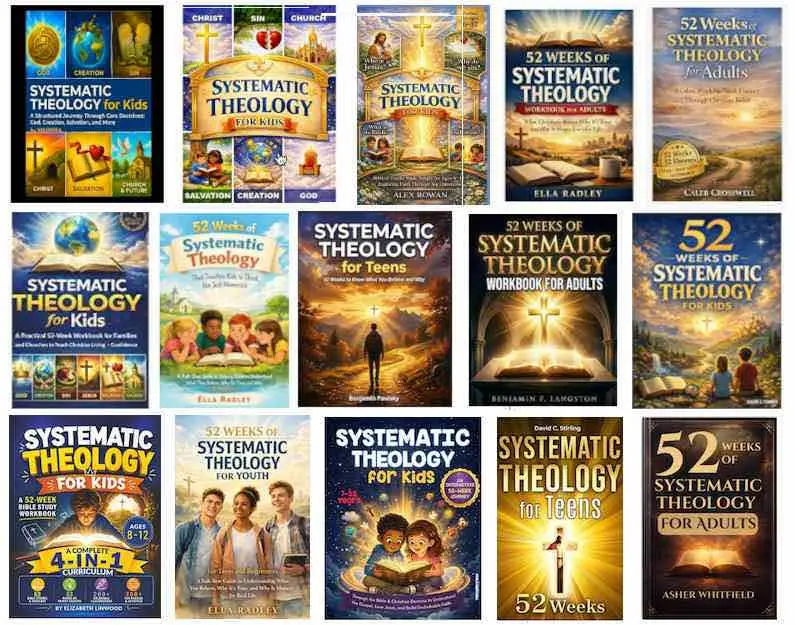
I don’t have any information on the content of these books, so I can’t say if they have used pirated copy. But the similarity in the titles and concepts, the fact that they all appeared around the same time, and the information on authors below suggests we should be wary of trusting them.
So many fakes
I have found more than a dozen authors of the various “Systematic Theology” workbooks. And they pretty much all have the following in common:
- The only books they have published seem to be these workbooks – some just one, others a bunch of workbooks covering children, teens, edults, etc.
- Each has a very generic bio, containing no details like church or academic affiliation, family, ministry experience, etc, and beginning with generic words like: “Elizabeth Linwood is a passionate author, educator, and curriculum creator dedicated to helping the next generation build a deep, unshakeable faith that lasts a lifetime.”
- The authors have no websites and no other information online.
- A few “authors” have names the same or similar to actual authors.
- Half don’t show photos, and the others have AI generated photos (below) – almost all the same size, similar backgrounds, similar clothing and poses.

The evidence suggests these authors are all fakes. (If you know otherwise, please tell me.)
But wait! There’s more!
Apparently before Valorrea made the Emily Carter post, they tried a slightly different approach. In 2025 a bunch of websites appeared under the name Christian Parenting Insider. Some had a Valorrea web address, but others have URLs like “faithsteps”, “theologyforkids” and “godisabove”. Some new sites have been published in the last month.
These websites have the following in common:
- They all use similar impassioned text about a youth pastor revealing the shocking truth why 73% of church kids abandon the faith. He has tested this new Workbook and it works! (How many years would it take to actually know if it works? They say 18 months.)
- Go to the purchase page and you’ll see discount offers, reasons to hurry, countdowns showing the special offer is closing soon, or something similar.
- Generally the pastor is Michael Chen from Texas, but sometimes it is exactly the same story, but the pastor is Michael Hartwell!
- Both Michael Chen and Michael Hartwell mention the same faithful Christian girl, Sarah Mitchell, who announced after leaving high school she had never believed. How could she be in both their congregations or youth groups?
- Michael Hartwell is an interesting character.
- He has an AI generated picture.
- He only appears online in connection with this workbook – even though he claims to be a principal of a Christian school, an online search can’t find him.
- But on another page he says he has led youth ministries for decades.
- His text is also notable for calling himself Mr Harrison at one stage! (Presumably they were pushing this stuff out so fast they didn’t have time for proof reading!)
- The different versions of the text all say this brilliant workbook series uses “constructive” or “constructivist” learning, in which “kids discover the truth themselves through a guided activity”. This is educationally and psychologically true, so if these workbooks actually use this approach effectively, they may actually have some value. But there is no evidence of this.
- The “verified, authentic reviews” cannot be verified and look fabricated.
- The text on the different sites is generally accompanied by an AI generated picture of a child reading the Bible, mostly with exactly the same text of the Bible highlighted and the same background, even though it is a different child (see below).
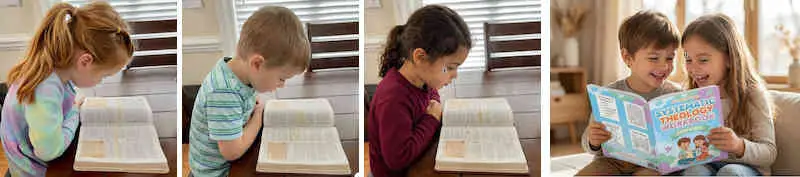

There is a bizarre approach on one page. It has more or less the same text, an AI child graphic, the same urgent appeals to act now. But instead of a workbook, it is advertising a jar of Bible verses that is going to save your child’s faith. For these aren’t just any Bible verses. The jar was created by “a team of apologists. theologians and child psychologists“! The jar containing Bible verses printed on coloured paper, as shown in the picture, costs $US30 even after a 60% discount!
The big picture
Apparently this type of activity – texts taken from regular books by AI, rushed into print, and advertised as cheap and original – is common these days. Amazon recognises the problem, and several high-profile non-fiction authors have been victims.
Sometimes it is direct piracy, other times AI is used to gather information and text from existing books and then create a “new” book from that information.
Most times, there is a familiar pattern:
- Find a proven, trending, or evergreen search term.
- Generate or lightly re-word a knockoff at industrial speed (often now AI-assisted).
- Launch it under a fabricated “author” persona with a generic bio, no real credentials, and no footprint outside Amazon.
We can only expect this to proliferate as long as money can be made easily this way.
What can we learn?
Recognise the pattern
The Valorrea and other workbooks follow the above pattern.
- “Systematic Theology for kids” and “52 weeks” became a popular search term, and was especially effective when accompanied by (manufactured) fervent Christian concern.
- Dozens of very similar workbooks appeared almost overnight in January 2026. The advertising contained inconsistencies and obviously copied text, signs of hasty compilation.
- The authors or publishing websites were clearly fabricated – no personal websites, no ministry affiliations beyond vague/unverifiable ones, no seminary credentials, no social media, no interviews, and AI generated “photos”.
These people have clearly found that some Christians will be taken in by fabricated stories and emotional pleas. Some genuinely concerned Christians will buy carefully packaged material if the advertising copy touches them.
Wise as serpents, harmess as doves
Living as a Christian requires us to have faith in Father, Son and Holy Spirit. Sadly, this can mean that we Christians carry over our trusting nature to others. Including what we read online.
Online fakery is so easy and so hard to detect. We need to be discerning and be wary of anything we read.
- Carefully check out offers that are presented as bargains if an imminent deadline is met – come back the next day and see if the deadline is consistent.
- Check out authors and publishing houses. Is there real information about the writer’s credentials and ministry?
- Look for signs of fabrication or AI generation.
- Search for online reviews, from established websites.
- Use sites like TrustPilot, ScamAdviser or similar, to check authenticity, and Whois to see if the website is new or well established.
- Newly established Facebook pages with very few posts should be treated with suspicion.
It’s a sad world that requires this vigilance, but we have to be realistic. If in doubt, check out what I have written on this page. I have given links and names, and an online search, especially if it includes “Systematic Theology for kids” and “52 weeks”, should give you verification.
Our concern for our kids is real
It would be terrible if these unethical books led to Christians not acting on concerns for the faith of their kids. The problems are real, even if this material exaggerates them and presents copied text.
Keep looking for good material. Check out Jenny Ingram’s book which is reportedly excellent. Pray for your kids. Examine your own faith and the reasons to believe and review the example you have given your kids.
I hope this page is as much an eye-opener to you as it was to me, and helps you avoid scams in the future.
Graphic: An AI generated image similar to the ones discussed here. This one was created by ChatGPT.
Read more on this site

Young adults who walk away from Jesus
Sadly, many young adults walk away from the faith they committed to as teens. What can we do about this?
Making young disciples in the 2020s
Ideas on passing on faith to the next generation, based on many years of experience.

Voting with their feet
How has the church been doing in recently? What things are working and what are causing problems?
Leave a Reply